
Part 2
Micro-SIM
Key question: Could a learner reach every outcome of this unit without ever attending your class?
Definition
A self-contained instructional package covering one full unit of a course, typically 1–3 hours of learner time.
A Micro-SIM is not a folder of Nano-SIMs. The difference is the connective tissue: the opener that sets expectations, the integration task that joins the parts, and the closer that consolidates. Remove those and you are back to content.
This is also the sweet spot for micro-credentials. A Micro-SIM already has stated outcomes, learner-paced material and its own assessment — the three things a micro-credential needs. Package one well-built unit with a graded final task and you have a stackable, certifiable offering, not just teaching notes.
Anatomy of a Micro-SIM
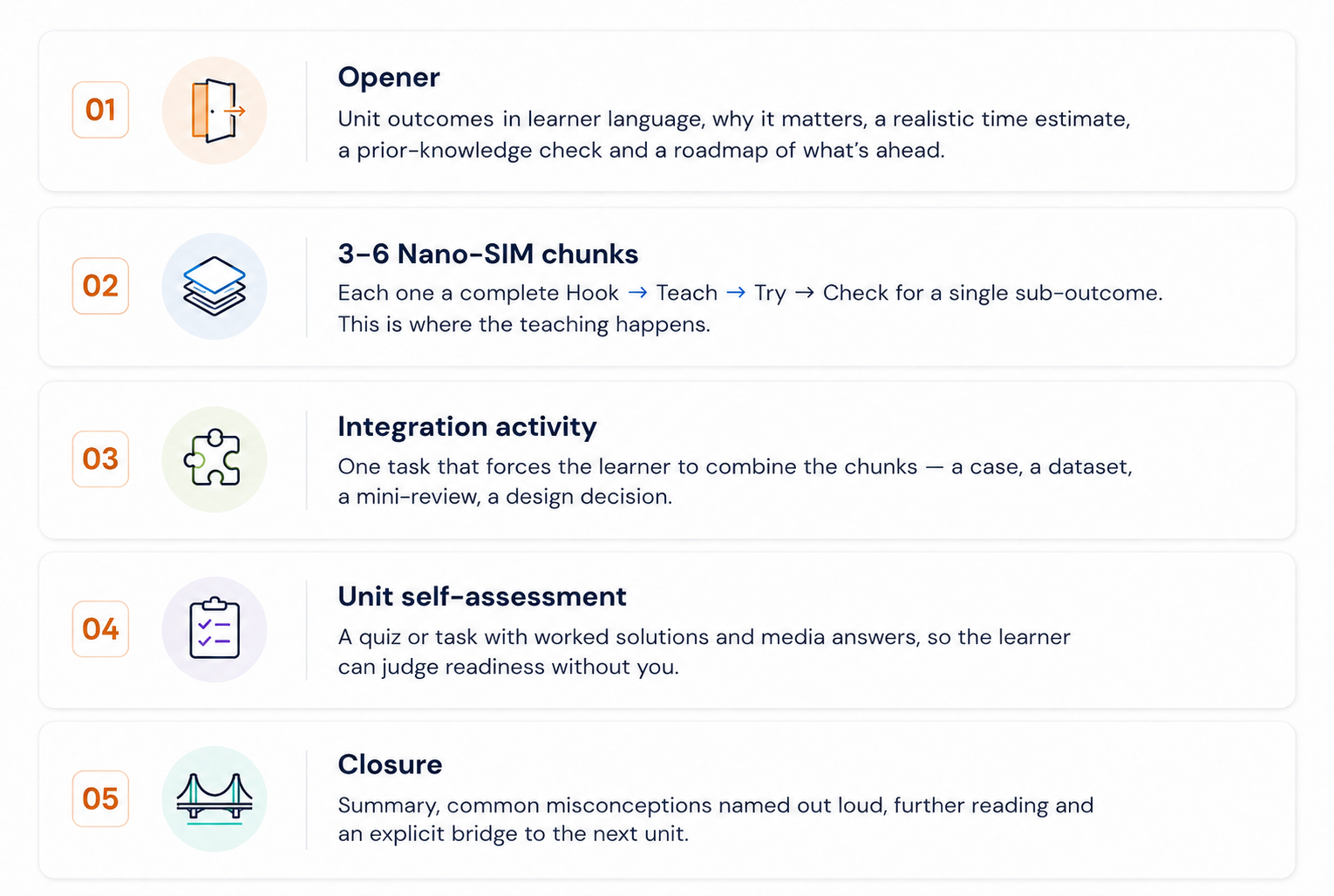
Micro-SIM video content: a worked example
At unit level the video work gets more streamlined: one consistent template, tighter narration and each clip mapped to a single chunk of the unit. This video example is created using the structure with the help of Canva Video Editor.
A realistic 5-day build sequence
Day 1
Write the unit outcomes and the self-assessment
Backwards design: if the assessment is vague, the unit will be too.
Day 2
Break the outcomes into 3–6 sub-outcomes
Each sub-outcome becomes one Nano-SIM. Name them before building any.
Day 3
Build or repurpose the chunks
Reuse existing recordings, slides and problem sets; wrap each with a Try and a Check.
Day 4
Write the connective tissue
Opener, roadmap, time estimates, summary, misconceptions, bridge. Mostly writing, no production.
Day 5
Test it
Do a quick test of all links, activities or resources to ensure it runs accordingly within the expected duration.
Five working days spread over two or three weeks is normal. Nothing here requires a studio, an instructional designer, or a new platform.
STEM and NON-STEM Examples
| Hypothesis Testing (STEM) | Writing a Literature Review | |
|---|---|---|
| Opener | Prior-knowledge check on sampling distributions | A bad review vs a good review, side by side |
| Chunks | Null vs alternative · p-values · one- vs two-tailed · errors and power | Search strategy · reading for argument · synthesis matrix · citing critically |
| Integration | Run a full test on a real dataset and report it | Write a 300-word mini-review from three given sources |
| Self-assessment | Quiz with worked solutions | Rubric plus an annotated model answer |
| Closer | “Significant does not mean important” misconception named | “Summary is not synthesis” misconception named |
Pitfalls and time-savers
Do this
- • Start with the unit you teach most often — the return on effort is highest.
- • Give honest time estimates per chunk; learners self-pace on your numbers.
- • Reuse one visual template across all chunks so the unit feels like one thing.
- • Name the misconceptions explicitly; that is your tutor voice doing its job.
Never do this
- • Don't dump six 40-minute recordings and call it a unit.
- • Don't leave the integration activity out — without it the chunks never join up.
- • Don't hide the outcomes in a syllabus PDF; put them at the top of the unit.
- • Don't rebuild everything from scratch when 70% already exists in your files.