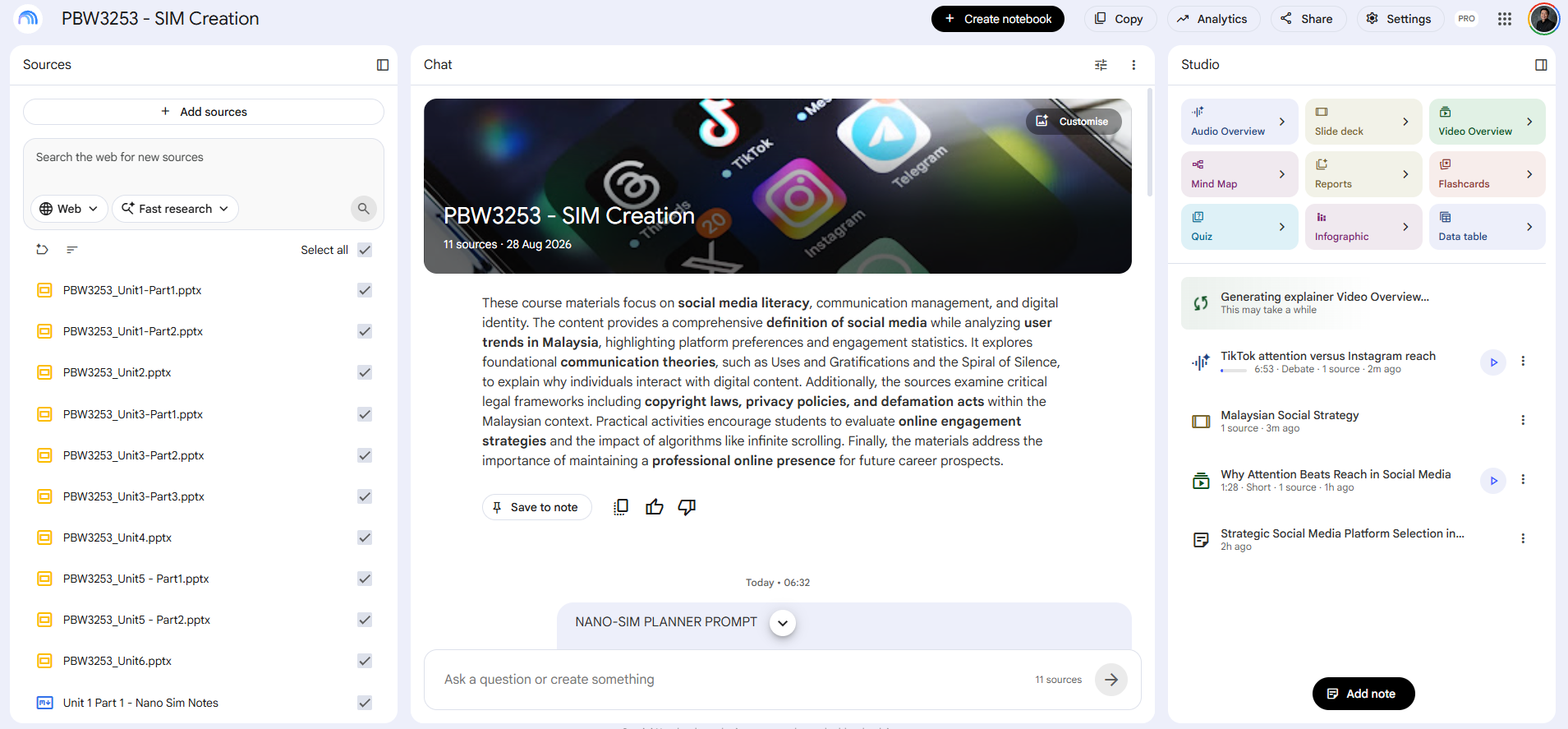
Google Gemini (NotebookLM)
SIM content creation from short videos to quiz questions.
START SMALL THEN SNOWBALL
Key question: What is the smallest thing you could finish building this week?
SIM content creation from short videos to quiz questions.
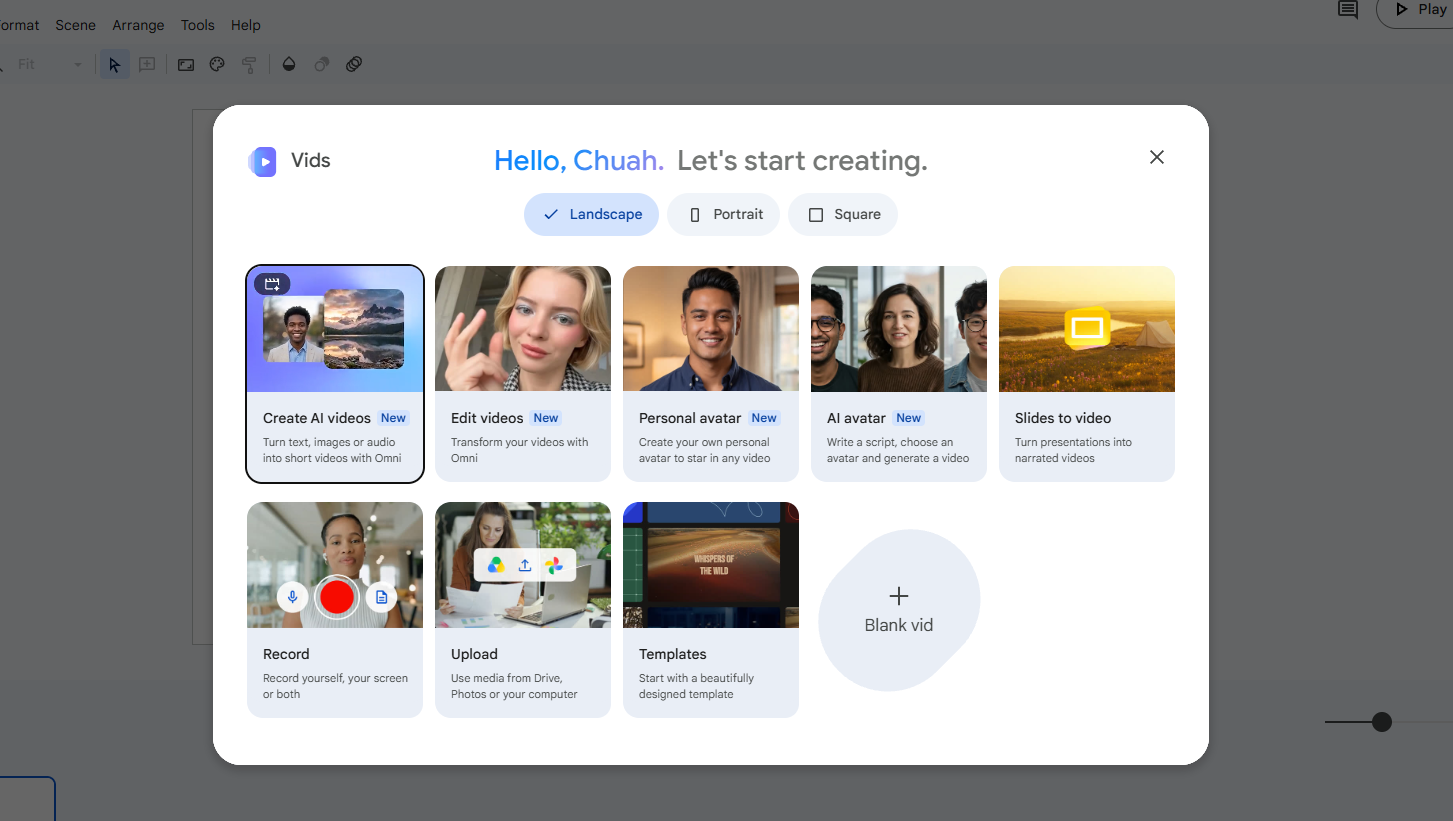
Rapid way to add tutorial voice to content and turn slides into narrated video.
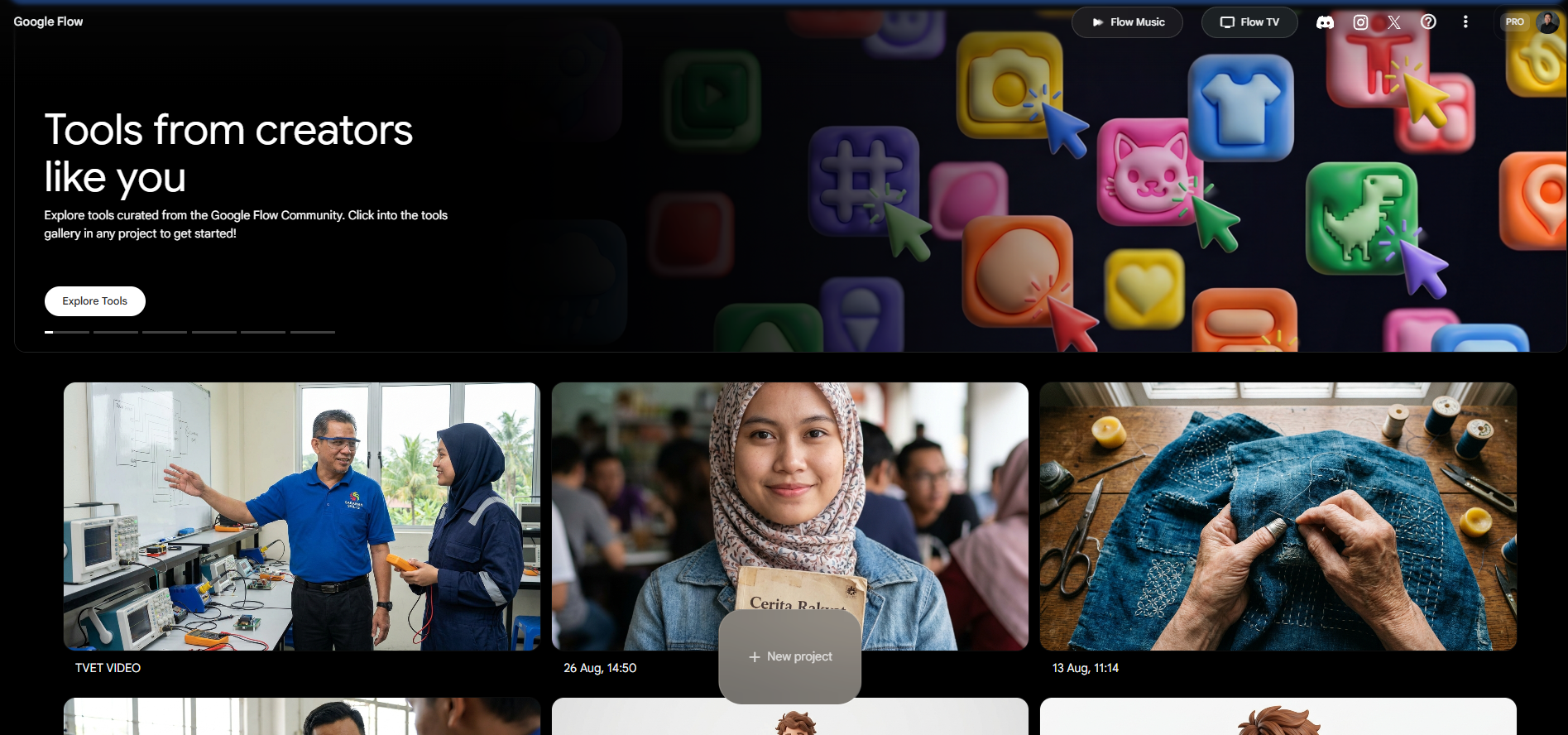
More advanced storyboarding for video creation.
| Size | Tools that work | Note |
|---|---|---|
| Nano-SIM | H5P, Canva, Slides with Voice Over, Google Vids, Google Forms or eLEAP Quiz, Gemini Notebook (NotebookLM), H5P | Whatever you already know beats whatever is newest. |
| Micro-SIM | LMS (e.g. eLEAP), Gemini Notebook (NotebookLM), Moodle Lessons, Google Flow | Structure matters more than the platform — pages with clear outcomes beat a fancy shell. |
| Macro-SIM | LMS + a course template, shared style guide, question bank | Institutional support becomes essential at this size. |
Nano-SIM planner
NANO-SIM PLANNER
Topic / pain point:
Learning outcome (one verb, no "and"): By the end, the learner will be able to ______.
HOOK (30 sec):
TEACH (3-6 min, 300-500 words, one example, one visual):
TRY (2-4 min, smallest application task):
CHECK (answer + explanation + what to do if wrong):
Format & tool:
Estimated learner time:
Where it sits in my unit:
Micro-SIM planner
MICRO-SIM PLANNER
Unit title:
Unit outcomes (2-4):
Estimated learner time:
Prior-knowledge check:
Chunk 1 (sub-outcome / format):
Chunk 2 (sub-outcome / format):
Chunk 3 (sub-outcome / format):
Chunk 4 (optional):
Integration activity:
Unit self-assessment + model answers:
Misconceptions to name in the closer:
Bridge to the next unit:
Macro-SIM blueprint
MACRO-SIM BLUEPRINT
Course / module title:
Target learners & entry level:
Total notional learner hours:
Course-level outcomes (3-6, aligned to programme outcomes):
Unit map (Micro-SIMs): title / outcome / learner time / assessment link
  1.
  2.
  3.
  4.
Assessment plan: formative checks per unit + summative task(s)
Alignment table: outcome -> activity -> evidence
Media & style guide: template, fonts, image sources, accessibility rules
Learner support: study guide, schedule, FAQ, contact points
Review cycle: peer review, pilot group, revision date
Paste into any assistant (e.g. Gemini, ChatGPT, Copilot). Replace the bracketed parts with your own course details, then edit the output — the pedagogy stays yours.
Outcome writer
Turns a vague topic into measurable, single-verb outcomes.
Act as an instructional designer. My topic is [TOPIC] for [LEVEL, e.g. Year 1 undergraduate] students in [DISCIPLINE].
Write 3 learning outcomes for a self-instructional material (SIM).
Rules: start with "By the end, the learner will be able to", use ONE observable Bloom verb each, no "understand/know/appreciate", no "and", and each outcome must be assessable in under 10 minutes.
Then, for each outcome, suggest one matching check activity.
Nano-SIM drafter
Produces a full Hook / Teach / Try / Check chunk.
Draft a 10-minute Nano-SIM on [TOPIC] for [LEARNERS].
Structure it exactly as:
HOOK (30 seconds, a realistic problem or misconception)
TEACH (300-500 words, plain language, one worked example, one suggested visual described in a caption)
TRY (one small application task with clear instructions)
CHECK (answer + why it is right + what to do if the learner got it wrong)
Constraints: conversational tutorial voice, address the learner as "you", no jargon without a one-line definition, minimise cognitive load (short paragraphs, no decorative detail).
Micro-SIM chunker
Breaks a week/unit into sequenced chunks.
I am building a Micro-SIM (60-90 minutes of learner time) on [UNIT TOPIC] for [LEARNERS].
Break it into 3-4 chunks. For each chunk give: sub-outcome, key ideas (max 4 bullets), suggested format (text, video, H5P, quiz), learner time, and one formative check.
Then propose: a prior-knowledge check at the start, one integration activity that combines all chunks, and a unit self-assessment of 5 items with model answers.
Sequence chunks from simple to complex and state the logic of the order in one sentence.
Tutorial-voice rewriter
Converts lecture slides or readings into SIM prose.
Rewrite the material below as self-instructional text that teaches in my absence.
Requirements: second-person tutorial voice; signal what is coming ("In this section you will...") ; explain, don't list; insert 2 embedded questions with answers the learner can self-check; add a "Common mistake" note; keep sentences under 22 words; end with a 2-line summary.
Do not add facts that are not in my material.
MATERIAL:
[PASTE YOUR SLIDES / NOTES / READING SUMMARY]Self-check & feedback generator
Quiz items with distractors and teaching feedback.
Create 6 self-check items for a SIM on [TOPIC] at [LEVEL].
Mix: 3 multiple-choice (4 options), 2 short-answer, 1 scenario-based.
For every MCQ distractor, state the specific misconception it targets.
For every item, write feedback that TEACHES: why the correct answer works, why the chosen wrong answer is tempting, and one next step.
Map each item to this outcome: [OUTCOME].
Worked-example builder
STEM or non-STEM, with a faded practice version.
Produce a worked example for [TOPIC] in [DISCIPLINE].
Give: (1) the problem or case, (2) a step-by-step solution where each step states the reasoning, not just the action, (3) a "watch out" line for the step learners usually get wrong, (4) a faded version of the same problem with the last two steps left for the learner, and (5) the answer key with explanation.
Alignment auditor
Checks outcomes, activities and assessment match.
Audit my SIM draft for constructive alignment.
Return a table: Outcome | Content that teaches it | Activity | Check/evidence | Verdict (aligned / weak / missing).
Then list: outcomes with no assessment, activities with no outcome, and content that serves no outcome (candidates to cut).
Be blunt and specific.
DRAFT:
[PASTE YOUR SIM OUTLINE]
Five self-tests reviewer
Quality check against the self- criteria.
Review the SIM draft below against five criteria and score each 1-5 with the exact evidence from my text:
1) Self-explanatory — can a learner follow it with no lecturer present?
2) Self-contained — is everything needed included or clearly linked?
3) Self-directed — is the learner told what to do and in what order?
4) Self-motivating — is relevance made explicit; is the tone encouraging?
5) Self-evaluating — can learners judge their own progress?
For each criterion give ONE concrete revision I can make in under 10 minutes.
DRAFT:
[PASTE DRAFT]
Accessibility & plain-language pass
Inclusive, readable, screen-reader friendly.
Revise the text below for accessibility and inclusivity.
Do: simplify to roughly [B2 / undergraduate] reading level, expand acronyms on first use, replace culture-specific examples with widely understood ones, write alt-text for every image I describe, convert dense paragraphs into meaningful headings and lists, and flag any instruction that relies on colour, sound or a mouse alone.
Return the revised text, then a short list of what you changed and why.
TEXT:
[PASTE TEXT]
Micro-credential packager
Turns a Micro-SIM into a stackable credential.
Turn this Micro-SIM into a stackable micro-credential proposal: [UNIT TOPIC], [LEARNER TIME] hours.
Provide: credential title, target learners, 3-4 outcomes, notional learning hours, evidence/assessment for each outcome, criteria for award (pass standard), skills tags for a digital badge, and how it stacks toward [PROGRAMME/COURSE].
Study-guide & schedule writer
The learner-facing front matter of a Macro-SIM.
Write the front matter for a Macro-SIM on [COURSE] with [N] units over [N] weeks.
Include: a welcome message (warm, 120 words), how to use this material, what you need before you start, a week-by-week study schedule with estimated hours, assessment overview with deadlines, study tips specific to this subject, and a short FAQ of 5 questions learners actually ask.
Tutorial-voice converter (instructions)
Turns flat, formal instructions into a warm conversational tutor speaking to one learner.
Rewrite my instructions below in a tutorial voice — as if I am sitting beside ONE learner guiding them.
Do: speak directly to the learner as "you"; say what they are about to do and why it matters in one line; break the task into numbered steps starting with an action verb; add a short "You'll know you're on track when..." cue; add one "If you get stuck" tip; keep sentences under 20 words and warm but not chatty.
Don't: add new requirements, change deadlines, marks or rules, or use words like "delve", "leverage", "embark".
Return: (1) the rewritten instructions, (2) a 2-line note on what tone changes you made.
MY INSTRUCTIONS:
[PASTE YOUR INSTRUCTIONS]
Conversational content rewriter
Converts lecture notes or slide content into conversational self-instructional prose with embedded dialogue.
Turn the content below into conversational self-instructional text that teaches when I am not there.
Style rules: second person ("you"); ask the learner a question before explaining, then answer it; use signposts ("First...", "Now try this...", "Notice that..."); use contractions; one idea per short paragraph; define each new term in one plain line; add an analogy the learner already knows.
Include: an opening line telling the learner what they will be able to do; 2 embedded self-check questions with answers hidden under "Check your answer:"; a "Common mistake" note; a 2-line "In short" summary.
Constraints: do not invent facts beyond my content; keep all technical accuracy; reading level around [B2 / Year 1 undergraduate].
Return the rewritten text only, ready to paste into my SIM.
MY CONTENT:
[PASTE YOUR NOTES / SLIDES]